
How to Pack a Moving Truck or Storage Unit Like a Professional: The Ultimate Guide
Moving is consistently ranked as one of life’s most stressful experiences. Much of that stress stems from the logistical challenge of fitting an entire household’s worth of belongings into a confined space—whether that’s a rental truck or a self-storage unit. If you have ever found yourself staring into a half-empty moving truck, frantically wondering where your remaining boxes will go, you aren’t alone. Achieving optimal packing efficiency is less about brute strength and more about smart spatial planning.
In this comprehensive guide, we will walk you through the essential techniques to maximize your space, protect your valuables, and save money on your next move. By using a scientific approach to spatial calculations and professional packing methods, you can ensure your move goes smoothly from start to finish. For those looking for the ultimate tool to manage this process, our Will It Fit In visual packing calculator is designed to help you determine your exact needs before you ever start loading.
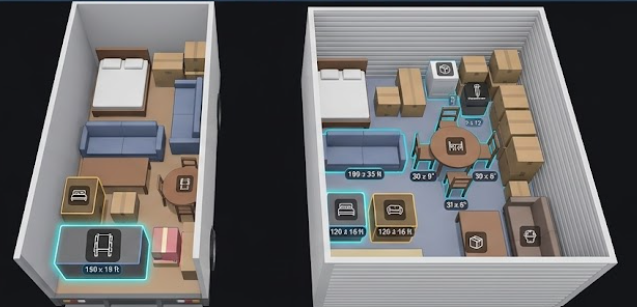
Pro Tips: How to Pack a Truck or Storage Unit Like a Pro
To ensure everything stays safe, secure, and fits perfectly during your move, follow these professional loading strategies.
- Build the “I-Beam” Base: Start by placing your heaviest furniture—such as refrigerators, washing machines, and tall dressers—firmly against the cab wall (the front) of the truck. Securing these items with strap rails creates a stable, solid “I-Beam” front wall, which is critical for keeping your load secure while the vehicle is in motion.
- Stack Vertically & Tightly: Once your base is set, stack sturdy cardboard boxes on top of your heavy appliances and bureaus. Always keep your heaviest items at the bottom of the stack and place lighter or more fragile items on top to avoid crushing. The goal is to eliminate empty airspace; never leave gaps, as they allow items to shift and fall during transit.
- Roll Mattresses on Sides: Never lay your mattresses flat. Place long queen or king-sized mattresses and box springs vertically along the side walls of the truck. They will act as protective padding cushions for your other delicate wood furniture items.
Frequently Asked Questions (FAQ) & Spatial Calculations
Estimating your storage or truck size scientifically is the best way to save hundreds of dollars on moving expenses. Avoid the common mistake of guessing by using our Will It Fit In tool to test your inventory against standard dimensions.
How do I calculate what moving truck size I need?
As a general rule of thumb, truck sizes are optimized for specific inventory loads. A 10-foot truck is typically built for studio or dorm moves (under 400 cubic feet of cargo). A 15-foot truck is generally sufficient for small 1-2 bedroom homes (up to 800 cubic feet), while larger 3-4 bedroom homes will likely require a 20-foot or 26-foot truck. Our visual packing tool helps you test your actual inventory on standard truck floors to avoid the costly mistake of renting the wrong size.
Will my furniture fit in a 10′ × 10′ storage unit?
A 10′ × 10′ storage unit provides 100 square feet of floor space and typically includes 8-foot ceilings, which equals approximately 800 cubic feet. This size is designed to hold the contents of a standard 1-to-2 bedroom apartment. You can easily accommodate your appliances, dressers, and tables by packing strategically—loading large beds vertically, stacking uniform boxes, and wrapping couches appropriately.
Why can’t I achieve 100% packing efficiency?
In a physical truck or storage locker, your items are rarely perfect shapes. Mattresses, couches, and bicycles leave non-orthogonal spaces (also known as “air pockets”) that standard boxes cannot fill. Because of this, professional packers usually assume a “stacking coefficient” or volumetric packing efficiency of only 70% to 80%. If our Will It Fit In calculator shows that your 3D volume usage exceeds 80%, we strongly advise moving up to the next available size.
How do I handle extremely heavy or delicate items?
Delicate items such as televisions, mirrors, and glass tables should never be placed flat on the floor or underneath heavy loads. We recommend packing these items vertically inside specialty wardrobe boxes or securing them safely between soft mattresses. Always put heavy appliances on the floor directly beneath lighter, sturdier cartons to prevent crushing during transit.
Why Use a Visual Packing Calculator?
The secret to a stress-free move lies in the preparation phase. Many people wait until the day of the move to see if their items will fit, leading to last-minute panic or the need for an additional, expensive rental truck. Our Will It Fit In app removes the guesswork by providing a digital environment where you can organize your items virtually.
By inputting your furniture dimensions and box counts, you can see exactly how the items will occupy the space on a standard truck floor. This is particularly important for renters who are dealing with limited budgets and want to ensure they aren’t paying for extra cubic feet that they don’t actually need.
Please note that the “Will It Fit In” app provides an estimate based on your inputs to help guide your planning, but actual results may vary depending on how items are loaded.
Beyond the Basics: Advanced Packing Tips
In addition to the “I-Beam” base and vertical stacking, consider these advanced tips to further enhance your moving experience:
- Label Everything by Room: Even if you know your boxes will fit, finding your items at the new location is the next hurdle. Clearly label every box by room and list the contents on the side of the box.
- The “First Night” Box: Pack a separate box with essentials like toiletries, chargers, basic tools, and a change of clothes. Keep this box in your car or at the very back of the truck so it is the last thing loaded and the first thing unloaded.
- Use Soft Items as Fillers: Use towels, pillows, and blankets to fill in small gaps between furniture to prevent them from moving. This keeps your soft items clean and provides extra protection for your hard furniture.
Final Thoughts
Moving is a major life transition, but it doesn’t have to be a chaotic one. By understanding how to properly build a stable load, stacking your items vertically, and utilizing tools like our Will It Fit In calculator, you are setting yourself up for success. Remember, when in doubt, refer back to the loading principles to keep your belongings protected during every mile of the journey.
Take control of your move today by planning ahead, calculating your space requirements, and loading with precision. Your future self—arriving at your new home with all your belongings intact—will thank you.